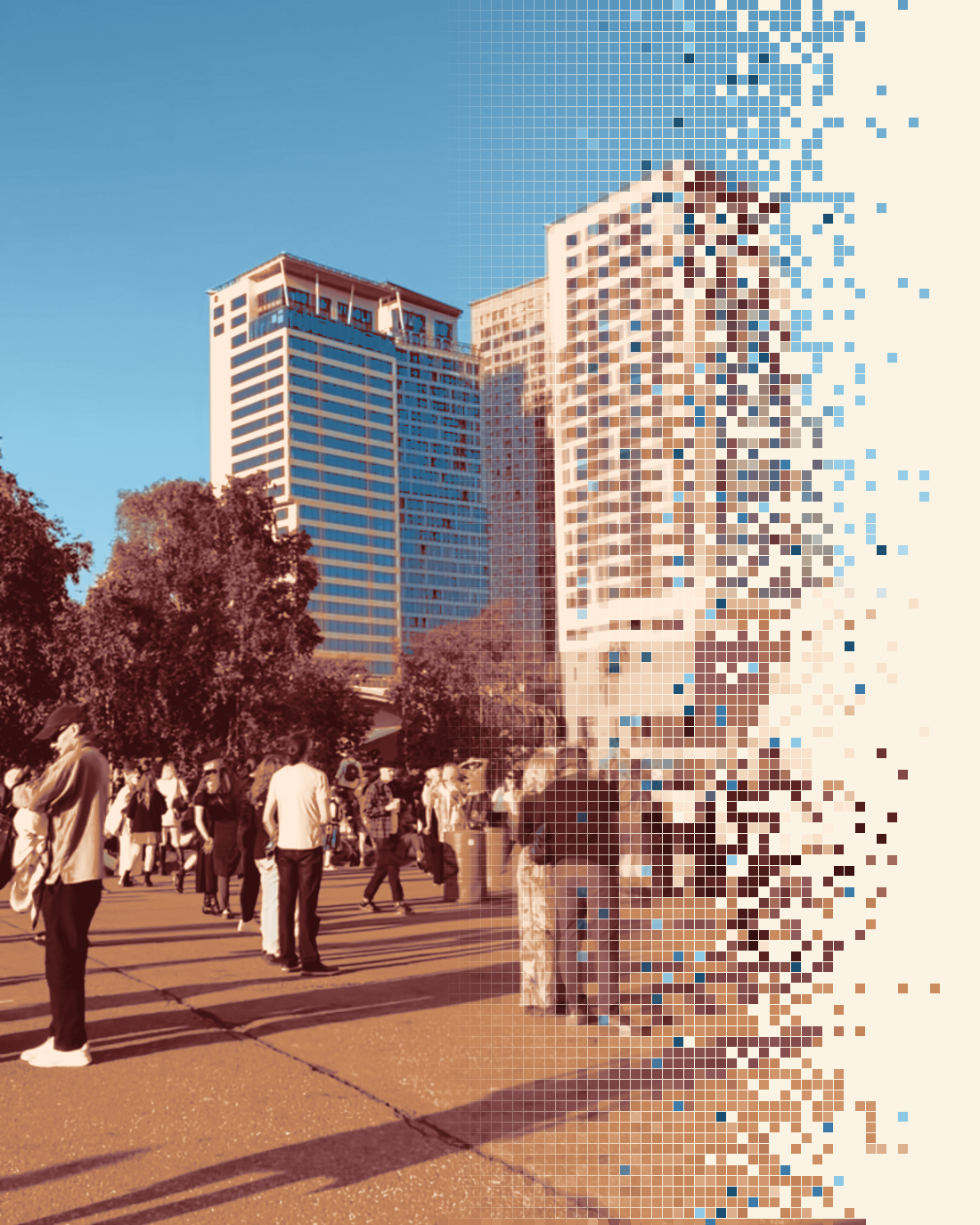
Flow Festival 2025
Loneliness has become one of the most pressing public health concerns of our time, and Finland leads the Nordics in loneliness among young adults aged 18 to 49 (Rotkirch and Artamonova, 2024). This is not about being single. It points to a structural difficulty in forming meaningful social connections.
Can urban design help? Yes, but not in the way we usually assume.
Density keeps friends, it doesn't make them
The standard planning answer to social life is the compact city: density, mixed uses, walkable streets. But a recent Turku study (Ishikawa, Kyttä and Rinne, 2026) found that compact urban living helps people maintain existing friendships, while it does not generate new ones. Walkability and parks along everyday routes helped, likely because they create repeated, low threshold encounters.
For a generation whose core problem is forming connections in the first place, that is a significant gap. Density is necessary, but not sufficient.
Communities now form around interests, not places
Contemporary communities are no longer bound primarily by neighbourhood but by shared passion, identity and lifestyle (Farahani, 2016). For Generation Z this is the baseline: their social world on Discord, TikTok and Instagram is organised entirely around interests and labels, not geography.
Those labels do real work. A visible marker of shared interest tells you, before any interaction, that you will probably be welcome. Physical public space rarely sends such signals. If a square has no legible identity, no sense of who it is for, why would it attract a generation used to clearly defined interest communities?
Design spaces that say who they are for
Helsinki's Oodi library shows the alternative. It is structured around specific interest communities, from fabrication labs and gaming rooms to reading zones, and its square has organically become a gathering point for K-pop dancers. Each space signals clearly who it is for.
The design principle: instead of building parks and plazas for everyone in general, identify communities of interest through co-design and give them explicit spatial affordances. Specificity creates belonging, and belonging creates the conditions for new ties.
Private developers belong in this picture too. Research from Manchester shows ownership matters less than management ethos (Kanellopoulou et al., 2025). The move is to write interest specific community spaces into planning conditions for major developments. Helsinki's planned Supercell headquarters at the old Maria Hospital site could be exactly this kind of laboratory.
The real measure
Perhaps the measure of a socially sustainable city is not its density or walkability scores, but something harder to quantify: whether a person can walk into a space and feel it was made for someone like them.
FAQ
Does building denser cities reduce loneliness?
Not by itself. Research from Turku shows compact urban living helps people maintain existing friendships, but does not predict the formation of new social ties (Ishikawa, Kyttä and Rinne, 2026).
What are communities of interest?
Communities bound by shared passion, identity or lifestyle rather than location (Farahani, 2016). For Generation Z, raised on interest based platforms like Discord and TikTok, this is the default way social life is organised.
How can cities design public space for Gen Z?
By making spaces specific rather than generic: identify interest communities through co-design and give them legible spatial affordances, the way Oodi structures itself around makers, gamers, readers and dancers. A clear signal about who a space is for lowers the threshold to participate.
What role do private developers play?
A significant one. Studies from Manchester show privately developed public space can serve communities well when inclusive management is built in, so cities should require interest specific community spaces in planning conditions for major developments (Kanellopoulou et al., 2025).